
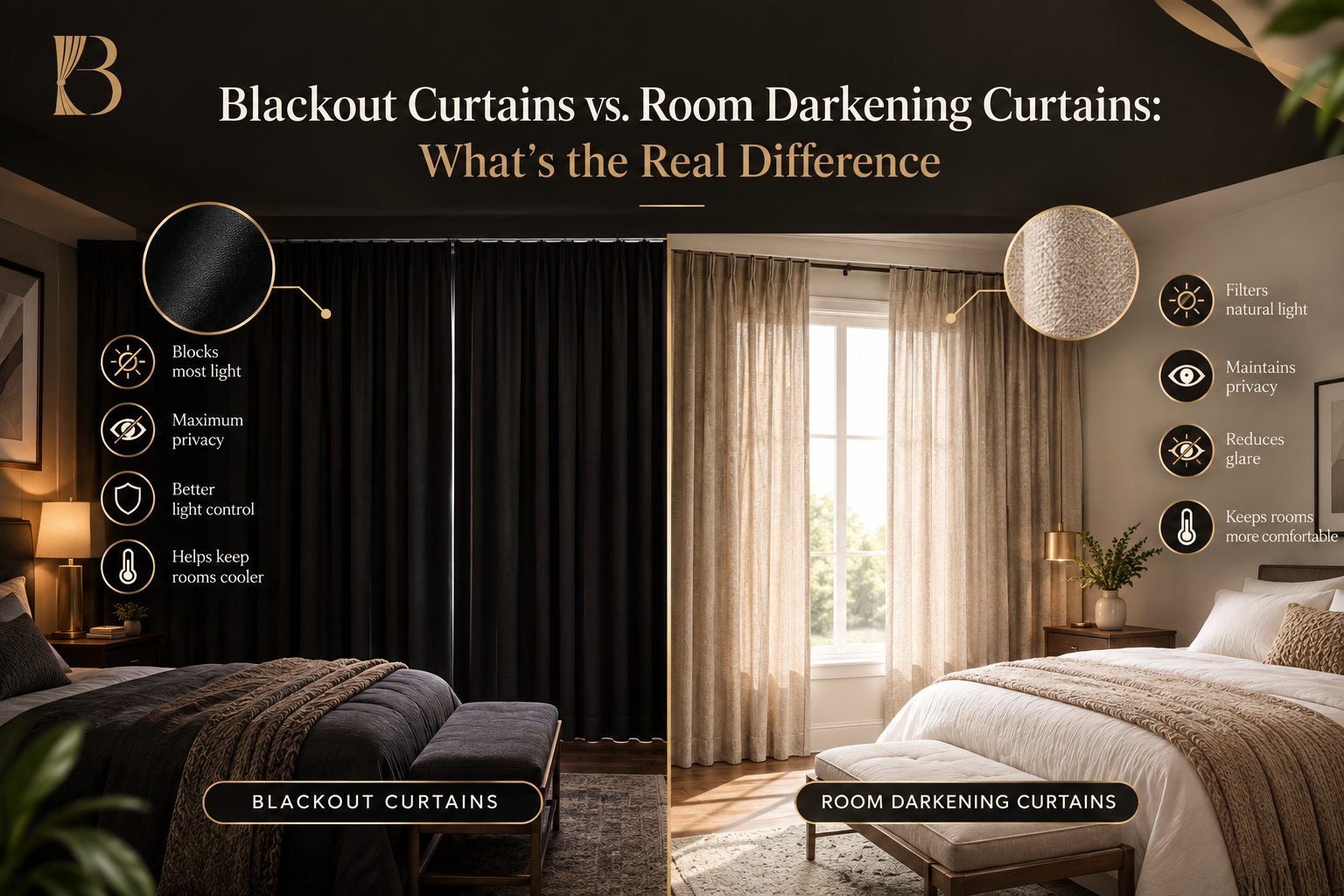
Blackout curtains block nearly all light, typically 95 to 100 percent, through a dense, layered or coated fabric built specifically to stop light from passing through. Room darkening curtains use heavier standard fabric without that dedicated lining, so they cut most light, usually somewhere around 70 to 85 percent, but let a visible glow through. Blackout curtains block 95 to 100 percent of light, while room darkening curtains reduce 70 to 80 percent. That gap, roughly a quarter of the light in the room, is the whole decision.
Both terms get used loosely by retailers, which is why the confusion exists in the first place. Here’s how to tell them apart and which one actually fits your room.
Blackout vs. Room Darkening: Quick Comparison
| Blackout Curtains | Room Darkening Curtains | |
|---|---|---|
| Light blocked | 95–100% | 70–85% |
| Construction | Multi-layer fabric or foam-backed lining built to stop light | Heavier standard fabric, no dedicated blackout lining |
| Best for | Bedrooms, nurseries, night-shift sleepers, home theaters | Living rooms, home offices, guest rooms, casual naps |
| Thermal insulation | Strong, dense layers add real insulating value | Moderate, some heat and draft reduction |
| Privacy | Complete, no silhouettes visible from outside at night | Good, but faint shadows can show with lights on |
| Typical price | Higher, due to extra lining and fabric weight | Lower, standard drapery fabric |
What Are Blackout Curtains
Blackout curtains are built with a fabric structure specifically designed to stop light from passing through the material itself, not just to look thick. That usually means one of three constructions: a foam-backed lining fused to the back of the decorative fabric, a triple-weave fabric with three tightly woven layers, or a separate blackout liner sewn or clipped behind a standalone drapery panel.
The distinction matters because “blackout” is a claim about the fabric, not a guarantee about the finished room. A 100% blackout label describes the fabric, not the finished room, since even a well-made blackout panel can leak light at the top, sides, or center gap unless it’s hung wide and high. A blackout curtain hung too narrow, on a rod that’s too short, will still glow around the edges no matter how good the fabric is.
What Are Room Darkening Curtains
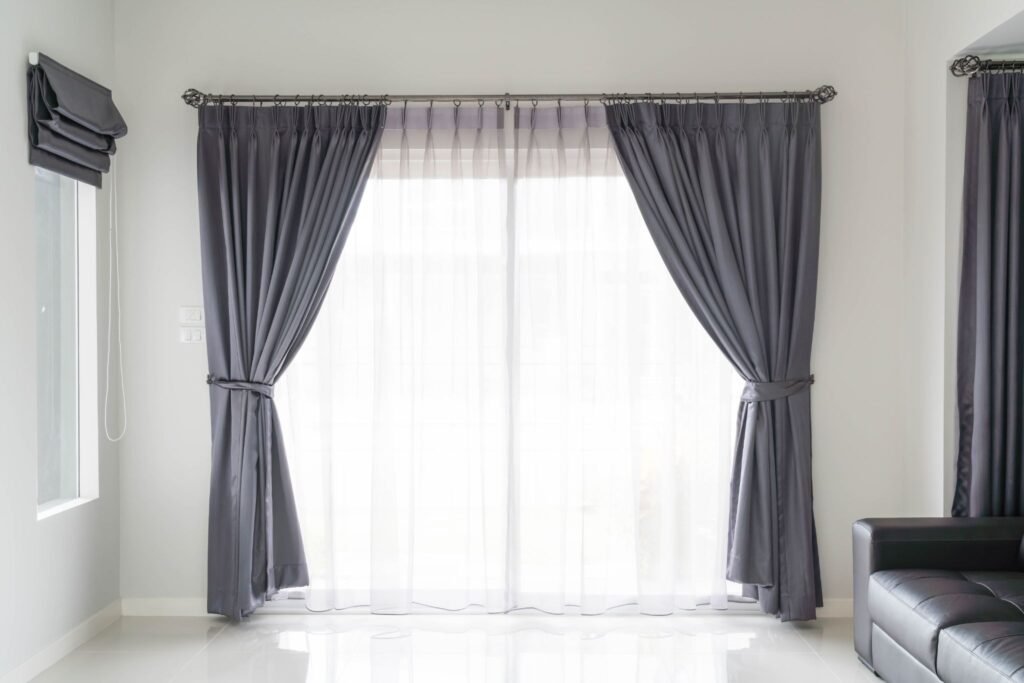
Room darkening curtains use a heavier version of standard drapery fabric, often a tighter weave or a darker color, without the dedicated blackout lining. They’re built to cut glare and dim a room significantly, not to eliminate light entirely. Think of them as the middle step between sheer or light-filtering fabric and true blackout: enough density to make a room noticeably dimmer and more private, but with a soft ambient glow still visible, especially around midday.
The Simplest Way to Tell Them Apart
Hold a lit flashlight against the fabric: with blackout curtains, you’ll see little to no light shine through, while room darkening curtains show a noticeable glow on the other side. This works better than reading a product label, since blackout and room darkening aren’t regulated terms and some retailers use them loosely.
Why the Light-Blocking Gap Actually Matters
This isn’t just a spec comparison. Light is the primary signal your body uses to regulate sleep. Research indicates light penetrates closed eyelids and inhibits melatonin production, the hormone that triggers sleepiness, and the National Sleep Foundation has identified light exposure as one of the most important factors in regulating the body’s sleep-wake cycle. For someone with a standard schedule and moderately bright streetlights, room darkening curtains may be dim enough. For a light sleeper, a shift worker sleeping during daylight hours, or a nursery that needs to stay dark through nap time and long summer evenings, that remaining 15 to 30 percent of light is often the difference between falling asleep quickly and lying there fully aware the sun is up.
Thermal Performance and Energy Costs
Both curtain types add some insulation, but blackout curtains, because of their extra fabric layers, generally do more. The U.S. Department of Energy has found that smart use of window coverings can reduce heat gain by up to 77 percent, and medium-colored draperies with a white plastic backing can cut heat gain by around 33 percent according to DOE research. Windows themselves are a major factor here: the DOE estimates that 25 to 30 percent of a home’s heating and cooling energy is typically lost through windows. That means the fabric choice matters, but so does how tightly the curtain seals the window opening. A blackout curtain that hangs loose on both sides won’t trap heat much better than a well-fitted room darkening panel.
Blackout Curtains: Pros and Cons
Pros:
- Blocks nearly all outside light, day or night
- Better thermal insulation from extra fabric layers
- Complete privacy, no visible silhouettes with lights on
- Works well for irregular sleep schedules
Cons:
- Higher price than standard or room darkening panels
- Heavier fabric, which can look bulkier in smaller rooms
- Fully dark rooms can make it harder to wake up naturally without an alarm
Room Darkening Curtains: Pros and Cons
Pros:
- Lower cost than blackout panels
- Lighter fabric, easier to pair with sheers or other layered looks
- Still cuts glare and adds meaningful privacy
- Lets in a soft glow, useful for waking naturally or checking on a sleeping child
Cons:
- Not dark enough for true light sensitivity or daytime sleeping
- Less thermal benefit than dedicated blackout fabric
- Can be inconsistent between brands, since “room darkening” isn’t a standardized spec
Which One Fits Your Room
Bedroom (adults): Blackout is the safer default, especially with streetlights, sunrise-facing windows, or an inconsistent sleep schedule. If you naturally wake with morning light and like it that way, room darkening is a reasonable middle ground.
Nursery or kids’ room: Blackout curtains help extend naps and hold bedtime consistent through long summer daylight, which matters more for toddlers and infants than adults since their sleep windows are shorter and more light-sensitive. Many parents pair blackout curtains for kids’ rooms with a nightlight rather than leaving the room fully lit.
Shift workers: Blackout is close to a requirement here, not a preference. Sleeping during daylight hours means fighting full sun instead of dusk-level light, and room darkening fabric usually isn’t dense enough to make that workable.
Living room: Room darkening usually wins. You want glare control for the TV and some privacy in the evening, but total darkness during the day isn’t the goal. Living room curtains in room darkening fabric also tend to drape better and look less heavy than full blackout panels.
Home office: Depends on your setup. If you’re on video calls or dealing with screen glare from a south-facing window, blackout or a heavier room darkening panel helps. Home office curtains in a mid-weight fabric often strike the right balance without making the room feel closed off.
Guest room: Room darkening is usually enough, since guests aren’t typically dealing with a fixed sleep schedule the way you are in your own bedroom.
The Mistake That Makes Blackout Curtains Fail
The most common complaint about blackout curtains isn’t the fabric, it’s the installation. A blackout panel that’s the exact width of the window will still leak light down both sides and across the gap where two panels meet in the middle. To actually get a dark room:
- Mount the rod several inches wider than the window frame so panels extend past the sides
- Hang the rod higher than the window frame, not directly above the glass, so panels cover the full height with room to spare
- Overlap two panels in the center rather than leaving a gap
- Use a rod pocket or grommet style that sits close to the wall to reduce light seeping around the top
Room darkening curtains benefit from the same installation approach, though the payoff is smaller since some light was always going to filter through the fabric itself.
Do You Need Both?
Some homeowners layer a light filtering or sheer panel with blackout curtains behind it, giving flexibility for daytime softness and nighttime darkness from the same window. If you’re weighing fabric types beyond blackout and room darkening, velvet blackout curtains and foam-backed blackout curtains are worth comparing directly, since foam-backed linings tend to block slightly more light than woven triple-layer fabric of the same price point.
FAQs
1. Do blackout curtains really block 100% of light?
The fabric itself can block close to 100 percent, but the finished room rarely does unless the curtains are hung wide and high enough to eliminate side and top gaps. Light almost always finds a way in around the edges if the panel is the same width as the window.
2. Are room darkening curtains good enough for a nursery?
For occasional naps, often yes. For consistent, extended sleep, especially during long summer daylight hours, blackout curtains hold up better since a nursery routine depends on darkness cueing sleep at the same time every day.
3. Do blackout curtains reduce noise too?
They provide some sound dampening from the extra fabric mass, but curtains alone are a modest noise reducer, not a substitute for actual soundproofing. If noise is the primary concern, pair curtains with weatherstripping or a denser window treatment built specifically for acoustics.
4. Are blackout curtains worth the extra cost over room darkening?
It depends on the room. For a primary bedroom, nursery, or any space where sleep timing matters, the extra cost is usually justified. For a living room or guest room where total darkness isn’t the goal, room darkening curtains deliver most of the benefit at a lower price.
5. Can I make room darkening curtains block more light without replacing them?
Yes. Adding a separate blackout liner behind an existing panel, or mounting the curtain wider and higher to close gaps, can noticeably improve light blocking without buying new curtains outright.
