
A small window needs more curtain, not less. That’s the part most people get wrong. The width of the fabric matters more than the size of the window itself, and the mounting method usually decides whether you get real darkness or just a dimmer room. Here’s what actually works, broken down by fabric construction, sizing, and the room you’re covering.
Why Small Windows Are Harder to Black Out Than Large Ones
A curtain doesn’t need to match your window. It needs to cover the wall space around it. On a large window, a few inches of gap at the edge is a small fraction of the total light source. On a small window, that same few-inch gap can be a third of the opening, so light leaks around the sides even when the fabric itself is dense and well made.
This is sometimes called the halo effect: a bright rim of light around an otherwise dark panel. It has nothing to do with fabric quality and everything to do with coverage. A small bathroom or kitchen window that measures 24 to 30 inches wide is a common casualty, because people buy curtains sized to the window instead of sized to the wall.
The fix is straightforward. Curtain width should run 1.5 to 2 times the width of the window, and the panel should extend 4 to 10 inches past each side of the frame. Length should clear the sill by at least 6 inches, or reach the floor if you want maximum coverage. Mount the rod 4 to 6 inches above the top of the frame so the curtain rises above the opening instead of starting at its edge.
Blackout Construction: What’s Actually Blocking the Light
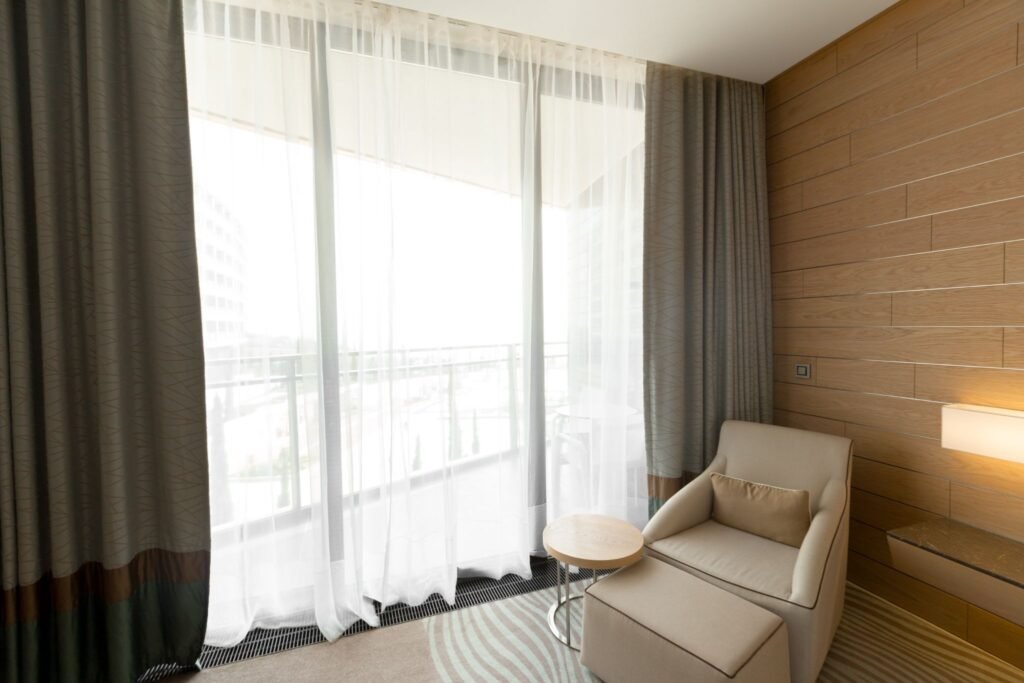
Not all curtains labeled blackout block the same amount of light. The label isn’t regulated, so the construction underneath it is what matters.
Coated fabric has a layer, usually foam or acrylic, bonded to the back of the material. A two-layer (two-pass) coating typically shows a dark or grayish backing and blocks most light. A three-layer (three-pass) coating adds a lighter, often white finish and generally blocks more, since each pass fills in gaps the previous layer missed. Coated fabric is the most reliable way to get near-total blackout regardless of the front color, since the coating does the work rather than the dye.
Triple weave uses three layers of yarn woven together instead of a chemical coating. There’s no risk of the coating cracking or peeling over time, and it tends to feel softer than coated fabric, but it depends more on dark, dense yarn to block light, so a pale triple-weave panel generally performs worse than a dark one.
Velvet is a naturally dense, heavy fabric that blocks a large share of light on its own, without a separate blackout layer. It also adds noticeable sound dampening, which matters in a small apartment bedrboom with a street-facing window, but it’s heavier and needs sturdier hardware than lighter fabrics.
| Construction | How It Blocks Light | Best For | Trade-off |
|---|---|---|---|
| Coated (2-pass) | Foam/acrylic backing, one layer | Budget blackout, any front color | Slightly less complete than 3-pass |
| Coated (3-pass) | Foam/acrylic backing, layered | Near-total darkness, shift workers, nurseries | Stiffer hand-feel |
| Triple weave | Dense woven yarn, no coating | Chemical-sensitive households, softer drape | Pale colors block less |
| Velvet | Natural fiber density | Bedrooms, sound dampening, cold climates | Heavy, needs real hardware |
If a listing doesn’t specify construction, check the back of the fabric in photos. A smooth, flat, single-color backing usually means coated. A backing that looks like the same weave as the front usually means triple weave.
How to Measure a Small Window for Blackout Curtains
- Measure the window width from outside edge to outside edge of the frame or molding, not the glass.
- Multiply by 1.5 to 2 to get your total curtain width. A 24-inch window needs 36 to 48 inches of fabric to hang with enough fullness to close without gapping.
- Add coverage beyond the frame. Plan for the rod to extend 4 to 10 inches past each side of the window, so the closed curtain overlaps the wall rather than stopping at the frame.
- Decide on length. Sill-length works for a kitchen or bathroom where you still want counter or vanity access below the window. Floor-length blocks more light and looks more finished in a bedroom.
- Mark the rod height 4 to 6 inches above the window frame, or closer to the ceiling if you want the room to read taller.
- Order them to that total width and length, not to the window’s own dimensions.
Standard Sizes vs. Custom Curtains for Small Windows
Small windows are exactly where standard sizing gets tricky, because most off-the-shelf blackout curtains are cut for average-size windows, not the 24 to 36-inch range common in kitchens, bathrooms, and half-baths. A handful of standard widths cover this range reasonably well: 42-inch panels for narrow windows, and short tier or cafe-style lengths (commonly sold around 24, 36, and 45 inches) built specifically for small kitchen and bathroom openings rather than trimmed down from a full-length panel.
If your window falls between standard sizes, or you want the curtain to extend well past the frame for full coverage, custom sizing removes the guesswork. It costs more, but it’s the more reliable route when a standard width would leave the panel too narrow to close without gapping.
Choosing Blackout Curtains by Room
Small windows show up disproportionately in a few specific rooms, and each one has different practical demands beyond just blocking light.
Kitchen Windows
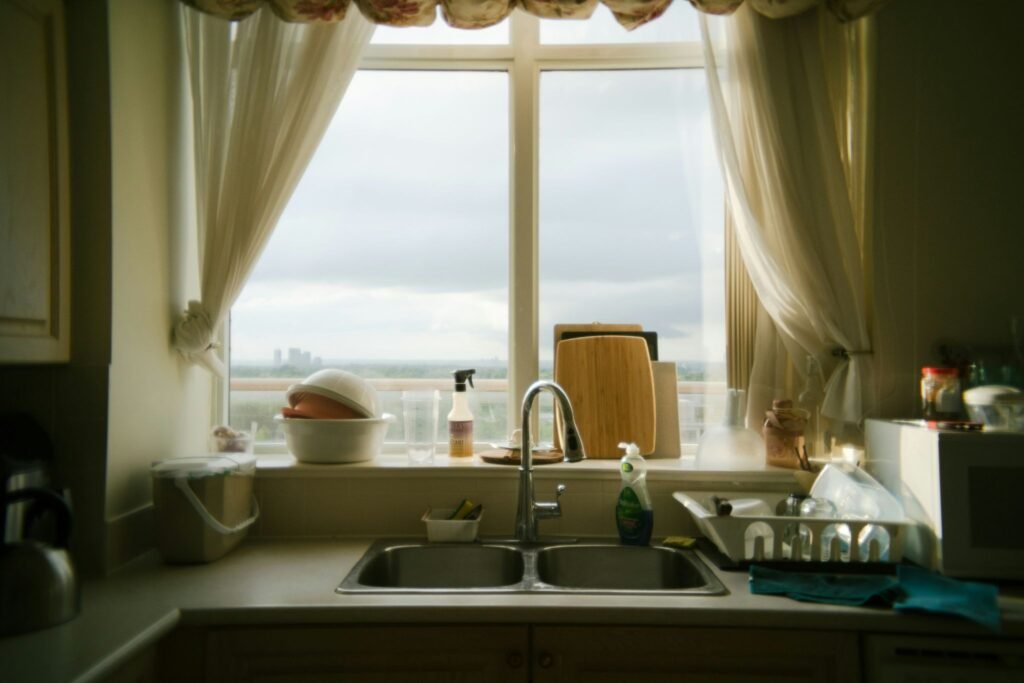
Kitchen windows are usually short and close to a heat source, so a cotton or polyester blend that resists grease and washes easily works better than velvet or anything with a delicate coating. Tier-style panels in 24 or 36-inch lengths are the standard fit here, since they clear the sink or counter while still covering the glass.
Bathroom Windows
Bathroom windows deal with humidity, so a synthetic or polyester-blend fabric that resists mildew holds up better over time than natural fiber. Shorter lengths that don’t drag near a tub or sink are also more practical than floor-length panels in most bathrooms.
Kids’ Rooms and Nurseries
This is the one room where cord safety matters as much as light control. The Consumer Product Safety Commission has flagged corded window coverings as a strangulation risk for young children, and cordless designs, including simple rod-and-panel curtains with no lift cord or hanging tieback cord, are the safer default. If you’re choosing between a curtain and a corded shade or blind for a nursery, the curtain is generally the easier way to stay cord-free, since it hangs from a fixed rod with no operating mechanism at all. Look for products noted as compliant with ANSI/WCMA A100.1, the current U.S. safety standard for window coverings, and keep the crib or any climbable furniture away from the window regardless of which covering you choose.
Small Bedroom Windows
Bedroom windows benefit most from true blackout construction, since this is the room where light leakage actually disrupts sleep. Coated fabric in a 3-pass construction, sized generously past the frame and mounted close to the ceiling, gives the most complete darkness. Pair it with a rod that overlaps slightly past center, or use a double rod with an overlapping return, to close the gap where two panels meet.
Hanging Blackout Curtains Without Drilling
Renters dealing with a small window have a few workable no-drill options, but the fabric weight limits which ones actually hold.
- Tension rods work for lightweight panels but tend to sag or slip under the weight of coated blackout fabric or velvet, especially on wider spans.
- Command-brand hooks rated for curtain rods typically support around 10 pounds, which is enough for a light or medium panel but not a heavy blackout or velvet curtain.
- Tap-in or adhesive brackets built specifically for curtain rods generally hold more weight, often up to 20 to 30 pounds depending on the product, and stay flush to the wall like a normal mounted rod.
For a small window carrying heavy blackout fabric, a tap-in bracket rated for the rod and curtain weight is the more reliable no-drill choice over a basic tension rod.
Do Blackout Curtains Actually Save Energy on a Small Window?
Yes, to a measurable degree, though a single small window won’t move your utility bill much on its own. The U.S. Department of Energy notes that windows account for roughly 30% of a home’s heating energy loss, and that an uncovered double-pane window lets about three-quarters of the sun’s energy through as heat during cooling season. According to the same source, closing medium-colored drapery with a light-colored backing on a sun-facing window can cut heat gain by around a third, and drawing conventional drapery at night in cold weather can reduce heat loss by up to 10%. Sealing the curtain at the sides and overlapping it at the center, the same technique that improves blackout performance, also improves this insulating effect, since it closes the air gap where heat escapes.
For a small window specifically, the effect is proportionally smaller than for a large picture window, but the fix is the same one that improves light-blocking: size the curtain to overlap the frame and hang it close to the glass.
Common Mistakes That Let Light Back In
- Sizing the curtain to the window instead of the wall. This is the single biggest cause of light leaking around a small window.
- Mounting inside the window frame. An inside mount looks tidy but leaves no room for the fabric to overlap the wall, which guarantees light gaps on a small window.
- Using a tension rod for heavy fabric. Coated blackout and velvet panels are heavier than they look, and a sagging rod creates a gap at the top where light pours in.
- Choosing grommet headers for maximum darkness. Grommets look clean but leave small gaps between each ring. Pinch pleat, tab top, and rod pocket headers sit tighter against the rod and block slightly more light at the top.
- Skipping the center overlap. Two panels that meet exactly at the middle, rather than overlapping by a couple of inches, leave a vertical strip of light down the center.
How to Choose: A Quick Decision Guide
- Want the darkest possible room: a 3-pass coated fabric, sized generously past the frame, in a rod pocket or pinch pleat header.
- Furnishing a nursery or kids’ room: cordless by default, washable fabric, no hanging tiebacks within reach.
- Covering a kitchen or bathroom window: a shorter, easy-wash polyester or cotton blend in a tier-length cut.
- Renting and can’t drill: a lighter linen-blend panel on a tap-in bracket rather than a tension rod, if the fabric is heavy.
- Want warmth and sound dampening along with darkness: velvet, mounted on real hardware rather than a spring-tension rod.
FAQ
1. Do blackout curtains need to be wider than a small window?
Yes. Total curtain width should be 1.5 to 2 times the window’s width, and the panel should extend several inches past each side of the frame. A curtain sized to match the window will leak light around the edges no matter how dense the fabric is.
2. What size curtains work best for a small kitchen or bathroom window?
Short tier or cafe-style panels, commonly sold in 24 to 45-inch lengths, are built for this. Full-length 84-inch panels are usually the wrong length for a window that sits above a counter or sink.
3. Are tension rods strong enough for blackout curtains?
For light to medium panels, generally yes. For heavy coated blackout fabric or velvet, a tension rod is more likely to sag or slip. A tap-in bracket or a permanently mounted rod holds heavier fabric more reliably.
4. Are blackout curtains safe for a nursery?
A cordless curtain is the safer choice over a corded blind or shade for a child’s room, since there’s no lift mechanism for a young child to reach. Look for cordless designs and keep the crib away from the window.
5. Do blackout curtains actually block heat as well as light?
They help. Closing a medium-colored, light-backed drapery on a sun-facing window can meaningfully cut heat gain, and drawing curtains at night in winter reduces heat loss, according to Department of Energy guidance. The effect scales with the size of the window, so a small window sees a smaller, but still real, benefit.
6. What’s the difference between blackout and room-darkening curtains?
Room-darkening curtains use a single dense layer of fabric that dims a room but still lets some light through. Blackout curtains add a separate coated lining or a multi-layer weave specifically built to stop light, and block close to 100% of it when sized and mounted correctly.
